
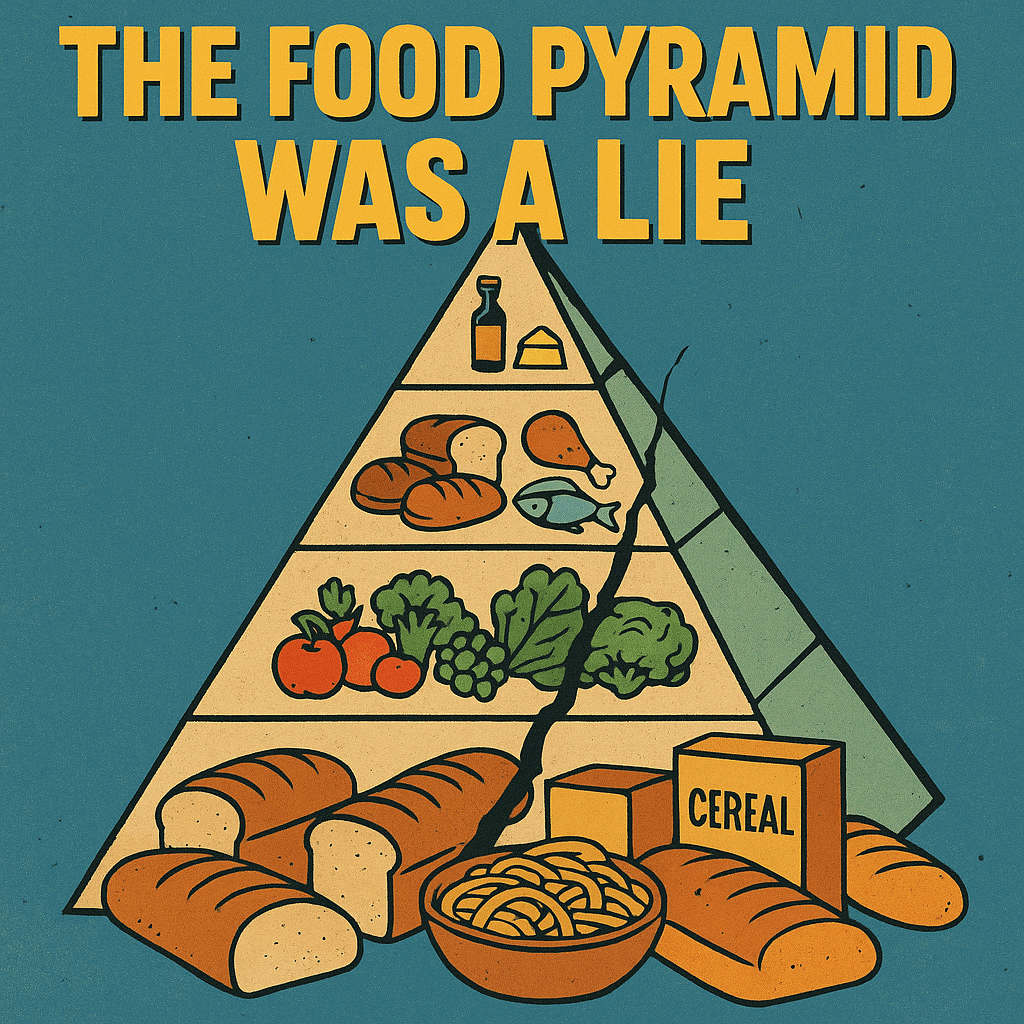
If you grew up in the 80s, 90s, or early 2000s, chances are you remember the Food Pyramid. That big colorful triangle was plastered on classroom posters, printed in textbooks, and drilled into our heads during “health” class. It was supposed to be the blueprint for a long, healthy life. Instead, it basically told an entire generation of kids to eat like we were carbo-loading for the Boston Marathon.
At the base of the pyramid — the foundation of a balanced diet — sat bread, cereal, rice, and pasta. Six to eleven servings a day, minimum. SIX TO ELEVEN. That meant a bowl of cereal for breakfast, a sandwich for lunch, spaghetti for dinner, and if you were really following the rules, maybe a bagel or two in between. According to the experts, this was the path to health. According to reality, it was the path to becoming the most bloated, sluggish generation in American history.
Turns out, the Food Pyramid was less of a guide to healthy eating and more of a marketing campaign for Big Agriculture. In other words: the Food Pyramid was a lie, and we millennials were the guinea pigs.
How the Pyramid Lied to Us
To understand just how badly we got played, let’s rewind to the 1970s and 80s. Back then, Americans were worried about heart disease, and researchers were trying to figure out if fat or sugar was the main culprit. A lot of the science was conflicting, but the loudest voices were the ones pointing at fat. So the government, food companies, and nutrition experts jumped on the “low-fat” train.
But here’s the problem: if you take fat out of food, it tastes like cardboard. The solution? Replace it with sugar and refined carbs. Suddenly, everything from yogurt to cookies to peanut butter had a shiny new “low-fat” label — and way more sugar than before.
Enter the Food Pyramid, officially rolled out by the USDA in 1992. It told us to avoid fats and oils like the plague while building every meal around bread, cereal, and pasta. In other words, the same people in charge of agriculture were now in charge of telling us what to eat — and surprise, surprise, their advice just happened to benefit the wheat, corn, and dairy industries.
The pyramid wasn’t a neutral science-based guide. It was politics. It was money. It was lobbying dressed up as nutrition.
Millennials and the Carbo-Loading Childhood
For us millennials, the Food Pyramid wasn’t just a chart — it was law. Teachers treated it like scripture. Cafeteria menus were designed around it. And parents genuinely believed they were doing us a favor by stacking our plates with “healthy” carbs.
- Breakfast: Cereal, toast, maybe a glass of orange juice (aka liquid sugar).
- Lunch: White bread sandwich, bag of chips, Capri Sun.
- Dinner: Spaghetti, garlic bread, maybe a token salad drowned in ranch.
- Snacks: Granola bars, crackers, cookies — all marketed as “healthy” because they were low-fat.
Looking back, it’s wild. We weren’t eating balanced meals — we were eating sugar disguised as nutrition. Even the so-called “healthy” options, like Special K or Nutri-Grain bars, were just candy bars in denial.
Meanwhile, fats — things like avocados, nuts, olive oil, or even butter — were demonized. “Too much fat will clog your arteries,” they said. So we avoided them like poison while doubling down on bagels, Pop-Tarts, and Cinnamon Toast Crunch. Spoiler: it didn’t work out great for our waistlines.
The Fallout: What the Pyramid Did to a Generation
The results of this decades-long food scam are pretty obvious today:
- The Obesity Epidemic
Childhood obesity rates skyrocketed during the very years the pyramid was being pushed. We weren’t “fueling our bodies” — we were fueling the junk food industry. - The Carbs Hangover
Millennials entered adulthood with food addictions, sugar crashes, and a warped sense of what “healthy” even meant. We grew up thinking a giant bowl of pasta was practically a salad. - The Fitness Catch-Up
Now, in our 30s and 40s, we’re obsessed with keto, paleo, intermittent fasting, Whole30 — basically anything that promises to undo the carb damage we accumulated in our childhoods. - The Mistrust
After the pyramid, it’s hard to trust any nutrition advice. One decade it’s “don’t eat eggs.” The next it’s “eggs are a superfood.” We’ve been jerked around so many times that now half of us just scroll TikTok waiting for some influencer to tell us what to eat.
But Why the Lies?
Here’s where things get even darker. The Food Pyramid wasn’t just bad science — it was business.
- Lobbying Power: The wheat, corn, and dairy industries had massive sway in Washington. If the government was going to create a “nutrition guide,” those industries wanted to make sure their products were front and center.
- Cheap Calories: Bread, cereal, and rice were cheap to produce and easy to store. Making them the foundation of the diet kept costs low and profits high.
- Marketing Madness: Once the pyramid came out, food companies went all-in on the low-fat, high-carb craze. Snackwells cookies, fat-free Pringles, sugary cereals — all pushed as “healthy” because they fit into the pyramid.
It wasn’t about health. It was about sales. And it worked.
The Millennial Reality Check
As adults, millennials are now the ones stuck cleaning up the mess. We’re the generation that:
- Can’t Afford a House, but can definitely tell you the difference between oat milk, almond milk, and soy milk.
- Spends Half Our Paychecks at Trader Joe’s, trying to balance “clean eating” with crushing inflation.
- Counts Macros Like It’s a Second Job, all because we grew up thinking a loaf of bread was a food group.
And honestly, it’s kind of funny — in a tragic way. Our parents told us milk would make us strong, bread would keep us full, and low-fat everything was the secret to health. Instead, most of us are lactose intolerant, carb-sensitive, and side-eying every “healthy” label in the grocery store.
The Joke’s On Us
The biggest joke of all? The Food Pyramid is basically gone now. In 2011, the USDA replaced it with “MyPlate,” a simpler plate graphic that actually promotes veggies and protein instead of drowning us in carbs. But by then, the damage was done. Millennials had already spent decades carb-loading like amateur athletes who never made it off the couch.
It feels like a prank someone pulled on our entire generation. Like: “Hey, let’s tell these kids pizza counts as two food groups and see what happens.” What happened was a lot of us are now on our third gym membership, trying to undo years of bread-based brainwashing.
Final Thought: The Pyramid Was a Lie
At the end of the day, the Food Pyramid wasn’t about health — it was about money. And millennials, more than any other generation, were raised on it. We were told to worship carbs, demonize fats, and trust the experts. But the experts were just middlemen for corporate interests.
So yeah, the Food Pyramid was a lie. And we’re the punchline — still figuring out if an English muffin is a wholesome breakfast or just another step toward dad bod destiny.